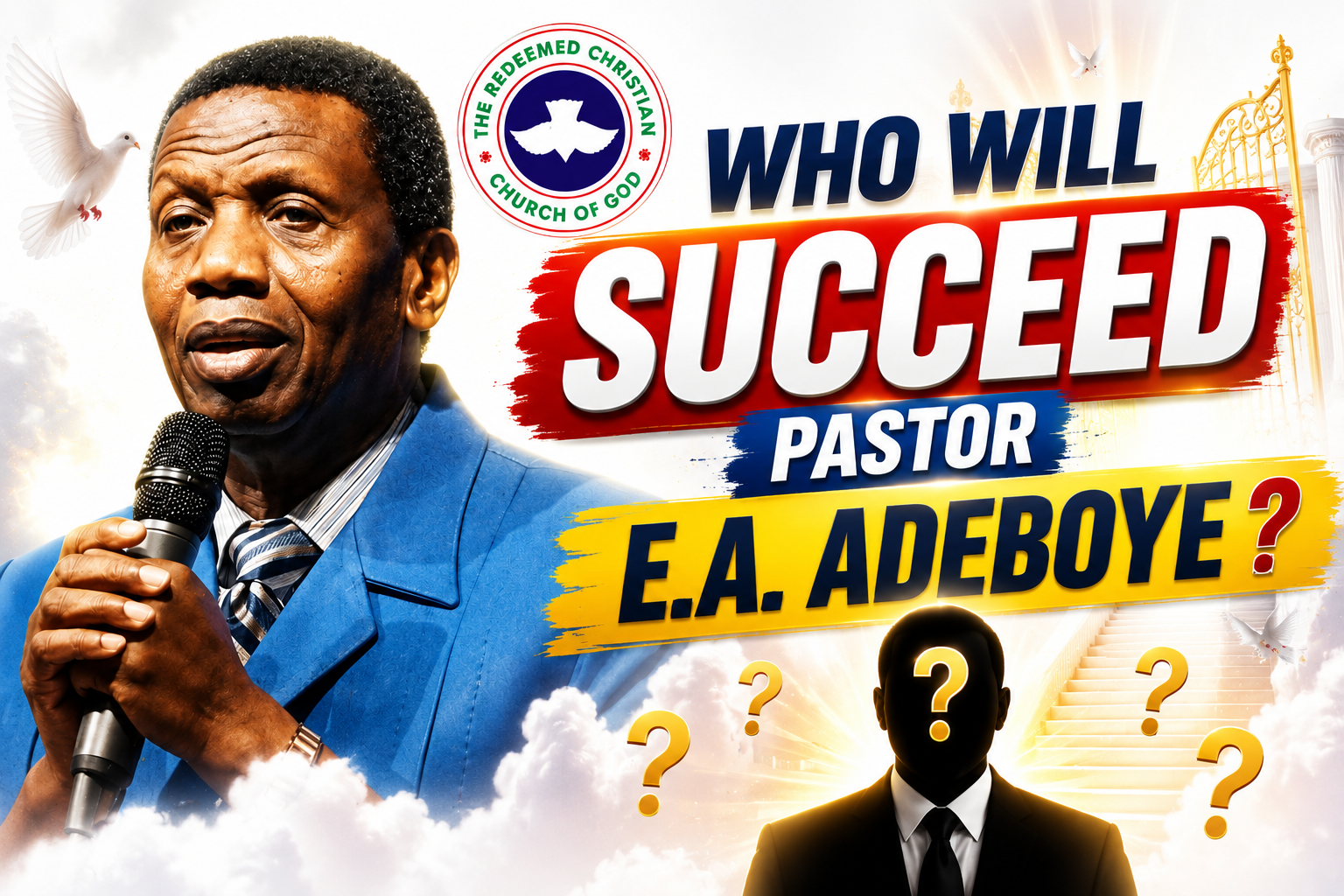
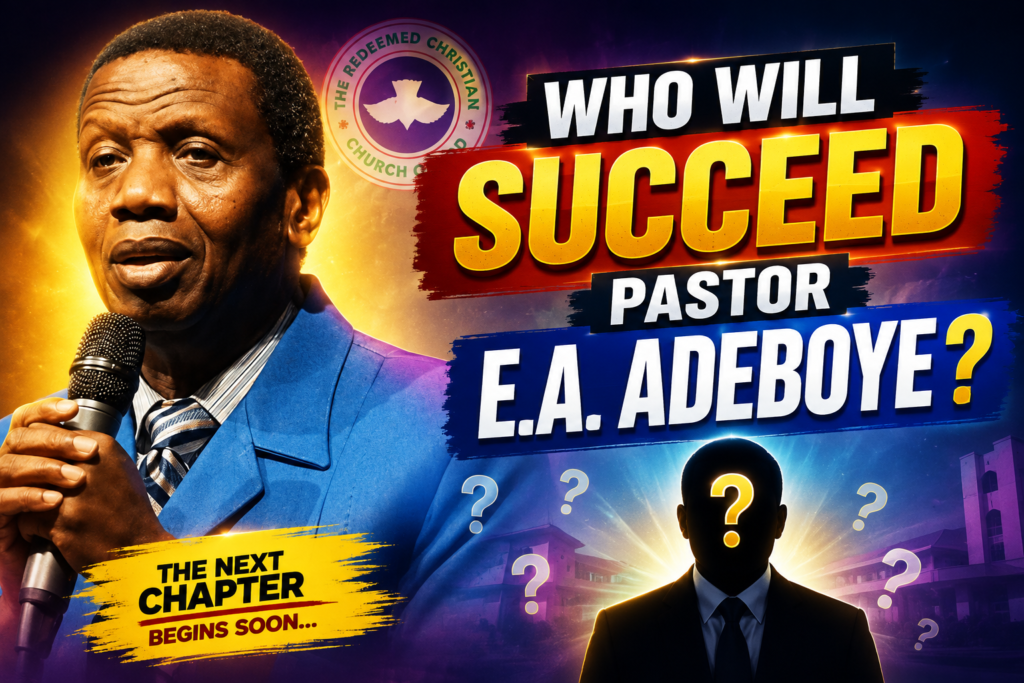
Who Will Succeed Pastor E.A. Adeboye? What to Know About RCCG’s Next General Overseer. RCCG Succession, Possible Successor and What We Know
Analysis
At 84, Pastor Enoch Adejare Adeboye remains the undisputed leader of the Redeemed Christian Church of God, one of the largest and most politically connected religious organizations in Africa. But behind the packed camp services and monthly Holy Ghost gatherings lies a question the church has never formally answered: who takes over when he is gone.
A church built on one man’s authority
Adeboye has led the RCCG since 1981, when he inherited the role from the church’s founder, Pa Josiah Akindayomi, who died in 1980 after sealing a written prophecy naming his successor. That succession, unusual and contested at the time, ultimately succeeded, transforming a modest Lagos congregation into a global network. By 2026, the RCCG reported more than 50,000 parishes across 197 countries and a membership exceeding nine million people. The RepublicThe Republic
Adeboye’s own hold on the position has not gone unchallenged. In 2016, Nigeria’s Financial Reporting Council attempted to enforce a 20-year term limit on heads of nonprofit organizations, a rule that would have forced his retirement as head of the church in Nigeria. The official who pushed the policy was suspended, and the code itself was scrapped by the federal government by January 2018. Adeboye responded by stepping down only as the church’s Nigeria overseer in January 2017, handing that specific post to Pastor Joshua Obayemi while retaining his title as General Overseer of RCCG Worldwide.
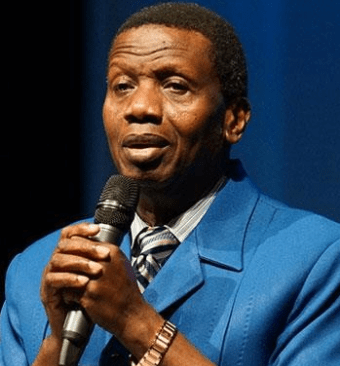
OPINION: Pastor Adeboye Should Name His Successor While He Is Still Here
By a concerned observer
I say this as someone who believes deeply in what Pastor Adeboye has built, not as someone looking to tear it down. But I have to be honest about something that troubles me, and I think it is worth saying plainly: I believe Pastor Adeboye should name his successor now, while he is still alive and able to guide the process himself, rather than leaving that decision to be discovered after he is gone.
Here is the thought experiment I want to put before you. Let us imagine, just for a moment, that God calls him home today. Not next year, not in ten years, but today. His book is closed. What happens to the Redeemed Christian Church of God the following morning?
If we are honest, nobody really knows. And that uncertainty is exactly the problem.
Right now, there are men around Pastor Adeboye who appear deeply loyal. They stand close to him at every service. They carry his bags, organize his schedule, speak on his behalf, and defend him publicly whenever controversy arises. I do not doubt that much of that loyalty is genuine. But Scripture warns us plainly about the limits of what we can know about a person’s heart. Jeremiah 17:9 tells us that the heart is deceitful above all things, and desperately wicked, and asks a sobering question: who can know it? That verse is not an accusation against any specific person. It is a warning about human nature in general, and it applies to all of us, including the people standing closest to power.
History gives us reason to take that warning seriously. We have already seen what happens in other Nigerian churches when a founder dies without a clear, uncontested successor. The Celestial Church of Christ fractured into rival camps after its founder’s death, a split that eventually turned violent over control of church resources. Other ministries have gone through painful, public disputes between children, deputies, and loyalists, each convinced they had the rightful claim to leadership. These are not hypothetical dangers. They are documented outcomes from churches that, like the RCCG, grew large enough that leadership came with real financial and political power attached to it.
The RCCG is not a small assembly anymore. It has grown into a global institution with tens of thousands of parishes, a presence in nearly two hundred countries, and enough political weight in Nigeria that presidents visit for prayer and blessing before elections. That is exactly the kind of institution where a leadership vacuum becomes dangerous. When there is no clearly recognized order of succession, and multiple loyal looking figures each have plausible claims, the temptation for quiet lobbying, alliance building, and self interested positioning becomes very real. People who spent years appearing humble and supportive in Pastor Adeboye’s presence may reveal a very different posture the moment his authority is no longer there to restrain them.
I understand the argument for keeping a successor’s identity private until death, following the same pattern as Pa Akindayomi’s sealed prophecy that named Pastor Adeboye himself back in 1981. There is a spiritual reasoning behind that method, and I respect it. But I would gently push back on relying on that same approach a second time. The RCCG of 1980 was a network of about forty parishes. The RCCG of today is an entirely different scale of institution, with far more at stake and far more people whose personal ambitions could be affected by an unclear transition.
My honest hope is that Pastor Adeboye will use his remaining years, in good health and full clarity of mind, to establish a transparent and public process for who leads after him. Not necessarily to name one individual immediately if he feels it is premature, but at minimum to put in place a clear structure that the entire church, not just an inner circle, understands and trusts in advance. Let the process be visible enough that no single group can quietly maneuver around it later.
This is not a call to question Pastor Adeboye’s wisdom or his decades of faithful leadership. It is a call to protect what he has built from the very real risks that come after any powerful leader departs without a clear plan in place. Scripture warns us that we do not always know what is truly in a person’s heart. Because of that warning, wisdom would suggest we should not leave something this important to be sorted out only after the fact.
No named heir
Despite decades of speculation, Adeboye has repeatedly declined to name a successor. In 2018, he told a ministers’ conference that God had not revealed a successor to him, dismissing rumors that he intended to hand leadership to fellow clergymen outside the church. According to one scholar who has studied the church’s governance structure, its constitution allows the General Overseer to serve for life and does not require him to name a successor publicly before his death.
That silence has fueled years of guessing. Names that have circulated publicly, according to reporting collected by The Republic magazine, include Pastor Joseph Obayemi, the church’s Nigeria overseer since 2017; Pastor J.T. Kalejaiye, a long-serving intercontinental overseer of evangelism; and Pastor Adebayo Adeyokunnu, Adeboye’s son-in-law and a deputy overseer in the United States. Also frequently mentioned is former Nigerian vice president Yemi Osinbajo, an ordained RCCG pastor whose political career has repeatedly intersected with the church’s rising involvement in Nigerian politics.
Adeboye’s own family has featured in the speculation as well. His son Pastor Leke Adeboye serves as his senior personal assistant and has appeared prominently beside him during church discussions of succession, though he has also drawn controversy for public remarks he later apologized for. Another son, Dare Adeboye, who was involved in church leadership in Akwa Ibom State, died in 2021.
A church that has moved into politics
Part of what makes the succession question consequential beyond church walls is the RCCG’s expanding footprint in Nigerian public life. In 2022, the church’s administrative leadership announced the creation of an internal “directorate of politics and governance,” instructing parishes worldwide to appoint coordinators tasked with voter education and mobilizing political support among members. Critics at the time, including politically active church members, argued the move was designed to support Osinbajo’s political ambitions, though church officials described it as a civic education effort open to members across the political spectrum.
Adeboye has also become more directly vocal on national security matters in recent years. In November 2025, he publicly called on Nigerian President Bola Tinubu to give security chiefs a 90-day ultimatum to defeat terrorist groups operating in the country or resign. The comments came amid heightened international attention on violence against Christian communities in parts of Nigeria. He separately apologized in October 2024 for earlier remarks suggesting tithing was a requirement for entering heaven, after the comments drew public criticism.
Analysts say this growing political visibility raises the stakes of succession considerably. Whoever eventually leads the RCCG would inherit not just a religious institution but a network capable of influencing elections and shaping relationships between Nigeria’s government and its Christian population, a role that has traditionally depended heavily on Adeboye’s personal relationships with successive Nigerian presidents.
Lessons from other Nigerian churches
Nigeria’s Pentecostal landscape offers cautionary examples of what can go wrong when a founder’s successor is unclear or contested. The Celestial Church of Christ splintered into competing factions after the death of its founder, with disputes over leadership eventually turning violent over control of church funds. The Church of God Mission International passed to the widow of its founder, while other prominent ministries have seen father-to-child transitions that generated public controversy. RCCG’s situation differs in one key respect: Adeboye did not found the church he leads, making it less clear whether a hereditary transition, should one be planned, would carry the same legitimacy that Akindayomi’s sealed prophecy gave Adeboye in 1981.
What comes next
For now, the RCCG’s official channels have not addressed the succession question directly, and Adeboye continues to appear at the church’s signature Holy Ghost services, including the annual New Year crossover service, where he delivers prophecies for the year ahead. Whether the church has a succession plan in place that simply has not been disclosed, or whether it faces the same uncertainty that surrounded Akindayomi’s death more than four decades ago, remains one of the most closely watched open questions in Nigerian religious life.
As the Redeemed Christian Church of God, RCCG, looks toward a future leadership transition, attention is increasingly turning to one central question: who will eventually succeed Pastor E. A. Adeboye? Beyond the identity of the next General Overseer lies an even bigger question: can the person who takes over preserve the wisdom, influence, stability and distinctive leadership style that have shaped RCCG under Pastor Adeboye?
The FRCN, Pastor Adeboye and the 20-Year Leadership Rule That Triggered a National Storm
On December 6, 2016, a regulatory dispute that had been developing quietly within Nigeria’s corporate governance system suddenly moved into the centre of the country’s religious and political conversation. At the heart of the controversy was Jim Obazee, then Executive Secretary of the Financial Reporting Council of Nigeria, and a governance framework that sought to impose stricter rules on not-for-profit organisations, including religious bodies.
The controversy became explosive because one of the country’s most prominent religious leaders, Pastor Enoch Adejare Adeboye, was directly affected.
The Financial Reporting Council had introduced a Code of Governance for Not-for-Profit Organisations as part of the broader National Code of Corporate Governance 2016. The framework addressed governance arrangements within organisations outside the conventional commercial sector and included provisions concerning the roles and tenure of founders and leaders. According to contemporary legal analysis by the Policy and Legal Advocacy Centre, the code was designed as part of a wider corporate governance framework developed under the Financial Reporting Council of Nigeria Act 2011.
One of the provisions became particularly contentious because it was understood to impose a 20-year limitation on the tenure of heads of religious and other not-for-profit organisations. That provision had an immediate implication for Pastor Adeboye, who had served as General Overseer of the Redeemed Christian Church of God since 1981.
The issue was therefore no longer an abstract debate about corporate governance.
It had suddenly become a question about whether a federal regulatory institution could determine how long the leader of one of Nigeria’s largest Pentecostal churches could remain in office.
How the FRCN Code Put Adeboye at the Centre of a Regulatory Dispute
The controversy surrounding the code was complicated by the fact that the FRCN maintained that its authority was derived from the Financial Reporting Council of Nigeria Act. The Policy and Legal Advocacy Centre explained that the 2016 framework contained separate governance codes for the private sector, public sector and not-for-profit organisations. The not-for-profit code covered what was also described as the third or benevolent sector, into which religious organisations fell.
The code stated that founders and leaders of not-for-profit organisations occupied special positions but should not necessarily hold indefinite control over an organisation. It also addressed situations where a founder or leader simultaneously occupied multiple governance positions.
This was where the issue became especially sensitive for RCCG.
Pastor Adeboye had already led the church for more than three decades. If the 20-year provision were applied to his position as the Nigerian General Overseer, the practical consequence was that a restructuring of the church’s Nigerian leadership would become necessary.
And that is precisely what happened.
In January 2017, Pastor Adeboye announced Pastor Joseph Obayemi as the leader of RCCG in Nigeria while making it clear that he would continue as the worldwide General Overseer. Contemporary reporting by The PUNCH said Adeboye cited the government regulation as the reason for the restructuring.
The arrangement created an unusual distinction between national and global leadership.
Adeboye was no longer positioned as the day-to-day General Overseer of the Nigerian arm under the arrangement, but he remained the global leader of RCCG.
That distinction would become central to the controversy that followed.
The Dispute Was Bigger Than RCCG
The confrontation was never simply about Pastor Adeboye.
The proposed governance framework affected religious organisations more broadly, and contemporary reports noted that other prominent religious leaders could also have been affected by the tenure provisions. The PUNCH reported that Adeboye himself referenced leaders including Bishop David Oyedepo, Pastor W.F. Kumuyi and Bishop Mike Okonkwo when discussing the potential implications of the regulation.
The debate therefore raised a fundamental question:
How far can a government regulator go in determining the internal leadership arrangements of religious organisations?
Supporters of stronger governance standards could argue that religious organisations, particularly large institutions handling significant assets and operating extensive administrative structures, should not be completely beyond accountability.
Critics, however, questioned whether a regulatory body created primarily around financial reporting and corporate governance had exceeded its proper boundaries by attempting to regulate the tenure of religious leaders.
That disagreement eventually reached the National Assembly.
On January 11, 2017, the House of Representatives called for a public hearing into the activities of the FRCN and questioned the legal basis of aspects of the governance code. Lawmakers raised concerns about whether the council had effectively assumed powers belonging to the National Assembly.
The controversy had therefore evolved from an internal regulatory matter into a broader constitutional and institutional debate.
Buhari Removes Jim Obazee as the Controversy Escalates
The situation changed dramatically on January 9, 2017.
President Muhammadu Buhari approved the immediate removal of Jim Obazee as Executive Secretary of the Financial Reporting Council and ordered the reconstitution of the council’s board. The Presidency also announced the appointment of Daniel Asapokhai as the new Executive Secretary and Adedotun Sulaiman as chairman.
The timing was striking.
The announcement came only days after Pastor Adeboye’s restructuring of RCCG’s Nigerian leadership had brought the FRCN code into national headlines.
However, it is important not to oversimplify the reason for Obazee’s removal. Contemporary reports said the dispute also involved an instruction from the Minister of Industry, Trade and Investment, Okechukwu Enelamah, to suspend implementation of the controversial provisions. The PUNCH reported that Obazee was removed after allegedly failing to comply with the directive.
This distinction matters.
It would be inaccurate to state as an established fact that Obazee was removed simply because he attempted to force Pastor Adeboye out of RCCG. The available reporting points to a wider dispute over the implementation of the governance code, the authority of the FRCN and Obazee’s relationship with the supervising ministry.
The Government Suspends the Code
Later on January 9, the Federal Government announced that the Corporate Governance Code had been suspended pending a detailed review, wider consultation with stakeholders and the reconstitution of the FRC board.
The announcement came from the Ministry of Industry, Trade and Investment. According to the statement reported by The PUNCH, the government said the review would involve extensive consultations and reaffirmed its commitment to strengthening the FRC’s ability to fulfil its statutory mandate.
Channels Television similarly reported that the code had been suspended and that the government intended to review its application.
The sequence of events was extraordinary:
Pastor Adeboye restructured RCCG’s Nigerian leadership.
The FRCN’s executive secretary was removed.
The FRCN board was reconstituted.
And the controversial governance code was suspended.
What began as a corporate governance initiative had become a national debate involving religion, government authority, institutional independence and the limits of regulatory power.
Was Obazee Targeting Pastor Adeboye?
This is one of the most controversial aspects of the story, and it requires careful treatment.
There were claims and counterclaims at the time suggesting that Obazee’s actions against RCCG were personal. Some reports portrayed the dispute through the lens of his previous relationship with the church and Pastor Adeboye.
But such allegations should not be presented as established fact without compelling evidence.
There is a more defensible interpretation of the episode.
Obazee was attempting to implement a governance framework that the FRCN said was based on its statutory responsibilities. The code was not written exclusively for RCCG or Pastor Adeboye. It covered a wider class of not-for-profit organisations. PLAC’s legal analysis described the code as part of a broader governance framework covering the not-for-profit sector.
The controversy arose because the general rule had an unusually direct consequence for one of Nigeria’s most influential religious leaders.
That distinction is important.
It allows the episode to be examined as a question of regulatory authority versus institutional autonomy, rather than reducing the entire affair to a personal feud.
The Question of Religious Autonomy
The deeper issue raised by the FRCN controversy was whether the internal leadership of a religious organisation should be subject to the same governance principles applied to conventional institutions.
There is a legitimate argument for transparency and accountability. Large religious organisations can control substantial assets, employ large numbers of people, operate schools and hospitals, run charitable programmes and maintain extensive administrative structures. Those activities can create legitimate public-interest questions around governance and financial accountability.
But leadership succession is different.
For a church, the identity and tenure of its spiritual leader can be deeply connected to its doctrine, internal constitution, history and understanding of divine calling.
That is why the attempt to regulate religious leadership through a corporate governance framework generated such a powerful reaction.
The controversy exposed a difficult boundary between accountability and autonomy.
The state has legitimate regulatory responsibilities. Religious organisations have legitimate institutional freedoms. The challenge is determining where one ends and the other begins.
What the Adeboye Episode Revealed About Power in Nigeria
The episode also revealed something broader about the nature of influence in Nigeria.
Pastor Adeboye was not merely the head of a local congregation. By 2017, RCCG had developed into a major international Pentecostal organisation with a vast network of congregations and a significant presence beyond Nigeria.
That scale meant that a regulatory decision affecting RCCG could generate reactions far beyond the technical environment of corporate governance.
It also demonstrated that formal government authority is only one dimension of power.
Religious legitimacy can be another.
Institutional credibility can be another.
Public trust can be another.
And when these forms of authority collide, governments have to consider not only what they are legally capable of doing, but also how their actions will affect public confidence and social stability.
The events of January 2017 therefore became an important case study in the relationship between the Nigerian state and powerful religious institutions.
The Most Important Lesson From the FRCN Controversy
The central lesson is not necessarily that Pastor Adeboye was more powerful than the Nigerian state, nor that the government was powerless before RCCG.
That interpretation would be too simplistic.
What the episode demonstrated was the difficulty of applying a general regulatory framework to an institution whose internal authority is rooted in religious belief, spiritual leadership and longstanding organisational traditions.
The Federal Government ultimately suspended the code for review and consultation, while Obazee lost his position as FRC Executive Secretary. The House of Representatives subsequently moved to examine the controversy and the legal foundation of the governance framework.
The result was therefore not simply a victory for one side.
It was a retreat from a regulatory approach that had generated enormous institutional and political tension.
And that history matters today because it provides an important backdrop to the question of who will eventually succeed Pastor E.A. Adeboye.
The 2017 episode showed that the leadership of RCCG is not merely an internal church matter. Because of the organisation’s enormous size, history and public influence, questions surrounding its leadership can quickly become matters of national interest.
The next succession will therefore be watched not only by RCCG members, but also by the wider Nigerian Christian community, political observers, scholars of Pentecostalism and anyone interested in the evolving relationship between religion and state power in Nigeria.
The question is no longer simply whether RCCG will have a successor.
The larger question is what kind of leader can inherit the institution Pastor Adeboye built, preserve its spiritual identity, maintain its organisational cohesion and navigate the complicated relationship between religious authority, public influence and the Nigerian state?
At first glance, the incident may have appeared to be little more than another bureaucratic disagreement between a religious organisation and the state. But beneath the administrative details was a much larger question about how power operates in Nigeria, particularly when formal government authority encounters an institution with extraordinary religious, social and public influence. What unfolded offered a revealing glimpse into the delicate space occupied by the Redeemed Christian Church of God, RCCG, and its General Overseer, Pastor Enoch Adejare Adeboye.
For decades, Pastor Adeboye has occupied a distinctive position within Nigeria’s religious landscape. His influence extends well beyond the pulpit, largely because of the extraordinary size and reach of the RCCG. With parishes spread across Nigeria and a substantial international presence, the church has developed into an institution capable of reaching communities at a scale few organisations can match. This extensive network has inevitably placed Pastor Adeboye and the RCCG within the wider national conversation, including conversations involving politics, governance, social welfare and public morality.
That influence has also made the relationship between Pastor Adeboye, political leaders and successive administrations a subject of considerable public interest. Nigerian politicians have frequently recognised the importance of engaging influential religious leaders, particularly in a country where faith communities play a significant role in public life. Such engagement should not automatically be interpreted as evidence that a religious leader controls political outcomes or directs how congregants vote. Rather, it illustrates the reality that prominent religious institutions can possess considerable social capital and can become important voices during periods of national uncertainty or political transition.
This is what made the incident particularly significant. It raised a broader question about the practical limits of governmental authority when dealing with a religious institution that commands enormous loyalty and public legitimacy. A government may possess formal legal and regulatory powers, but exercising those powers against a major religious institution can carry consequences that extend beyond the immediate dispute. The reaction of congregants, religious leaders, civil society and the wider public can transform what initially appears to be an administrative matter into a much larger national conversation about religious freedom, institutional independence and the proper boundaries of state intervention.
In that sense, the episode became a revealing test of institutional power. It demonstrated that influence in Nigeria is not exercised solely through constitutional offices, government departments or political parties. Religious institutions, traditional authorities, business organisations, civil society groups and other major social institutions can also command significant forms of legitimacy. Pastor Adeboye’s position within this ecosystem is particularly noteworthy because of the size, longevity and international reach of the organisation he leads.
It would therefore be too simplistic to describe the incident merely as a government retreat or a victory for Pastor Adeboye. A more useful interpretation is that it exposed the difficult balance between the authority of the Nigerian state and the autonomy of powerful religious institutions. The government must retain its ability to regulate institutions where the law requires it, while religious organisations have legitimate expectations of independence in matters protected by law. Finding the boundary between those two interests can become especially complicated when the institution involved has millions of followers and a deeply established place in society.
This broader context is essential when considering the future of RCCG leadership. Pastor Adeboye’s influence is not simply a product of his personal charisma. It has also been reinforced by decades of institutional development, an extensive pastoral network and the trust that generations of members have placed in the church. The question facing RCCG after Adeboye, therefore, is not merely who will occupy the office of General Overseer. It is whether the next leader will inherit an institution whose influence has become deeply embedded in Nigeria’s religious and social fabric, and whether that leader will possess the same capacity to navigate the complicated relationship between church, state and society.
As Soneye Ayomide Joseph, a lecturer and researcher in church history at Caleb University who has studied leadership, mentorship and sustainability within RCCG, has observed in his research on the relationship between Pa Josiah Akindayomi and Pastor Enoch Adeboye, the sustainability of a major Christian movement depends on more than the identity of an individual leader. It also depends on how leadership is transferred, how institutional values are preserved and how the next generation is prepared to carry the organisation forward. His research provides an important framework for understanding why the question of succession at RCCG extends far beyond the simple naming of a replacement for Pastor Adeboye.
The real question, therefore, is not simply who comes next. It is whether the person who eventually assumes the leadership of RCCG can preserve the institutional stability, spiritual authority and public credibility that have helped make the church one of Nigeria’s most influential Christian organisations.
The state’s eventual retreat should not be interpreted simply as a “defeat” of secular authority or as evidence that government institutions were incapable of exercising their regulatory powers. Rather, it can be understood as a pragmatic recalibration of the principle of institutional autonomy. The situation demonstrated the delicate balance that exists between the legitimate authority of the state and the independence of major religious institutions operating within a democratic society.
The RCCG occupies a unique position within Nigeria’s social and religious landscape. Its enormous membership, extensive network of churches, educational institutions, charitable activities, community programmes and international presence have given it a level of social legitimacy that cannot easily be separated from broader questions of national stability and public confidence. Any attempt by government to impose formal regulatory measures on such an institution therefore requires considerable sensitivity, particularly where the proposed intervention could be perceived by members and the wider Christian community as an intrusion into religious affairs.
In this context, the state’s decision to retreat can be viewed less as an abandonment of its constitutional responsibilities and more as an acknowledgment of the practical limits of regulatory intervention. While government retains the authority to establish and enforce laws, the exercise of that authority must take into account the autonomy of religious organisations, the rights of their members, and the potential social consequences of aggressive intervention. The RCCG’s influence means that decisions affecting its institutional operations can extend beyond the immediate organisation and generate wider reactions across communities.
Ultimately, the episode highlights the complex relationship between secular authority and religious legitimacy in Nigeria. The state must preserve its regulatory mandate while recognising that institutions such as the RCCG are not merely private organisations in the conventional sense. They are also influential social institutions with significant roles in shaping public values, community relationships and national discourse. Consequently, effective governance requires a careful balance between accountability and autonomy, ensuring that regulation is exercised lawfully and transparently without unnecessarily destabilising institutions that remain important stakeholders in Nigeria’s social cohesion and national stability.
Who Will Succeed Pastor E.A. Adeboye? RCCG Succession, Possible Successor and What We Know
The question of who will eventually succeed Pastor Enoch Adejare Adeboye as General Overseer of the Redeemed Christian Church of God, RCCG, continues to attract attention among church members, Christians and observers of one of Africa’s largest Pentecostal movements. Pastor Adeboye remains the General Overseer of RCCG, and there is no verified announcement on the church’s official website naming his successor.
The succession question is therefore one that must be approached carefully. There is a significant difference between discussing possible candidates, reporting public speculation and announcing an officially confirmed successor. RCCG has specifically warned media organisations, bloggers and commentators against presenting unverified claims concerning Pastor Adeboye or the church as established facts. The church says official positions should be verified through its authorised communication channels.
Who Is Likely to Succeed Pastor E.A. Adeboye?
At present, there is no publicly confirmed successor who can responsibly be described as the next General Overseer of RCCG.
The church’s history, however, provides an important perspective on how leadership succession has worked in the past. According to RCCG’s official history, Pa Josiah Akindayomi, the founder of the church, was told that his successor would be a young, educated man who was not yet a member of the church. When Enoch Adeboye joined RCCG in 1973, Pa Akindayomi eventually recognised him as the person he believed God had indicated would succeed him. Adeboye was ordained a pastor in 1975 and later succeeded Pa Akindayomi following his death.
That history is significant because it shows that RCCG’s previous transition was not simply a matter of choosing the most visible member of the founder’s family. It involved spiritual conviction, leadership development and the formal process through which the founder’s succession decision was recognised.
Consequently, it would be premature to declare that any particular RCCG pastor is certain to become the next General Overseer without an official announcement.
Has RCCG Named Pastor Adeboye’s Successor?
There is currently no verified public announcement on RCCG’s official website naming a successor to Pastor Adeboye.
The official RCCG website continues to identify Pastor E.A. Adeboye as the General Overseer, and the church continues to publish his sermons, programmes and ministry activities through its official platforms.
This is particularly important because succession stories can quickly become distorted when social media discussions, predictions, personal opinions or comments by individuals are presented as official church decisions.
RCCG itself has recently issued a clarification addressing what it described as false narratives and misleading commentaries concerning the church and Pastor Adeboye. The church urged the public and publishers to verify claims through its official public relations channels before treating them as the position of RCCG.
Therefore, until RCCG officially announces otherwise, the responsible position is that Pastor E.A. Adeboye remains the General Overseer and no successor has been publicly confirmed by the church.
What Happened to the Previous Succession of RCCG?
The most important succession in RCCG’s history was the transition from its founder, Pa Josiah Akindayomi, to Pastor E.A. Adeboye.
RCCG’s official history states that Pa Akindayomi had received what he understood to be a divine indication concerning his eventual successor. Adeboye, then a university lecturer, joined the church in 1973 and became involved in translating Pa Akindayomi’s Yoruba sermons into English. He was ordained in 1975.
According to the church’s account, Pastor Adeboye had also received a revelation about becoming Pa Akindayomi’s successor before the founder’s death. After Pa Akindayomi died at the age of 71, Adeboye’s appointment was formalised through the reading of the founder’s sealed pronouncement after his burial.
That historical account is useful when considering the current succession question. It demonstrates that RCCG’s leadership transition has previously involved more than popularity or public speculation.
Who Are the Prominent Leaders Around Pastor Adeboye?
RCCG has a large and complex leadership structure, with pastors and leaders serving across its many levels of administration and ministry.
Because the church operates internationally, leadership is not concentrated in a single individual apart from the office of the General Overseer. RCCG’s official platforms describe a broad organisational structure and a worldwide missionary presence. Its official website currently states that the church has more than 50,000 parishes and operates an extensive digital and evangelistic network.
Several senior RCCG leaders have therefore attracted public attention over the years. However, being a prominent pastor, member of the governing structure or close associate of Pastor Adeboye does not automatically mean that the individual has been designated as his successor.
This distinction is particularly important when discussing members of the Adeboye family. Pastor Leke Adeboye, for example, publicly dismissed speculation in January 2026 that he was positioning himself to become the next General Overseer. He described the position as a major spiritual responsibility and stated that he was not aiming to become the General Overseer.
That statement is significant because it directly challenges the assumption that Pastor Adeboye’s biological son would automatically inherit the leadership of RCCG.
Does RCCG Have a Succession Structure?
RCCG’s history indicates that succession has been connected to the church’s spiritual and organisational leadership rather than simply hereditary inheritance.
The story of Pastor Adeboye’s emergence after Pa Akindayomi illustrates this clearly. The founder’s successor was identified through a process that the church describes in spiritual terms, followed by formal recognition of the succession.
The church’s present structure is also extensive. RCCG has developed from its beginnings in Nigeria into a global Christian organisation with thousands of congregations and an international missionary presence.
This means that any future transition would be significant not only for RCCG members in Nigeria but also for its congregations and ministries around the world.
Could Pastor Adeboye’s Son Become the Next General Overseer?
This is one of the questions that naturally arises whenever the subject of RCCG succession is discussed.
However, there is currently no official basis for stating that one of Pastor Adeboye’s children will succeed him.
The public statement by Pastor Leke Adeboye is especially relevant. In January 2026, he rejected the idea that he was seeking the position, saying that being the General Overseer’s son did not mean he was aiming to become the General Overseer.
That does not determine who will eventually lead RCCG. It simply means that claims portraying Leke Adeboye as the confirmed or self-declared successor should not be presented as established fact.
Why Is the Succession Question Attracting So Much Attention?
Pastor Adeboye has become one of the most recognisable Pentecostal Christian leaders in Africa. His leadership has been associated with the extraordinary expansion of RCCG from the period following Pa Akindayomi’s death to a global organisation.
RCCG’s official history records the church’s rapid growth after 1981 and its expansion across Africa, Europe, the United States, the Caribbean and other parts of the world.
The scale of the organisation naturally makes any future leadership transition an important subject.
There is also a strong personal connection between Pastor Adeboye and millions of RCCG members who refer to him affectionately as Daddy G.O. The question of who could eventually occupy his office therefore carries emotional, spiritual and organisational significance.
Yet the importance of the question makes accuracy even more necessary.
What We Know About Pastor Adeboye’s Current Position
As of the latest information available from RCCG’s official platforms, Pastor E.A. Adeboye remains the General Overseer of the Redeemed Christian Church of God Worldwide.
The church continues to publish his sermons and ministry activities. Its official materials also continue to refer to him as the General Overseer. A 2026 RCCG fasting and prayer guide, for example, contains prayers for Pastor Adeboye and describes his continuing leadership role in the church.
Therefore, reports suggesting that a successor has already been appointed should be treated with caution unless they are supported by an official RCCG announcement.
So, Who Will Succeed Pastor E.A. Adeboye?
The honest answer is that we do not yet know.
There are prominent leaders within RCCG who could potentially play important roles in the church’s future, and there is understandable public curiosity about who might eventually emerge. But potential leadership, public speculation and official succession are three different things.
RCCG has not publicly confirmed a successor on its official website, and Pastor Adeboye remains the church’s General Overseer.
For now, the most accurate conclusion is that the succession question remains open to the church’s future leadership process.
Any future announcement should come through RCCG’s official communication channels. Until then, Christians and readers should be careful about social media claims, predictions and reports that identify a particular pastor as the next General Overseer without verifiable evidence.
The story of RCCG’s previous transition from Pa Akindayomi to Pastor Adeboye shows that succession can unfold in ways that are not necessarily obvious from public speculation.
For millions of believers watching the future of RCCG, the question may remain unanswered for now. But when the church eventually announces its next General Overseer, it will mark one of the most consequential leadership transitions in the history of African Pentecostal Christianity.
The Weight of an Unwritten Name
There is a particular kind of silence that settles over a man who has outlived every ordinary expectation of his own significance. Pastor Enoch Adeboye carries that silence with him now, in the pauses between his sentences, in the long look he sometimes gives a congregation before he speaks, as though he is listening for something the rest of us cannot hear. He is eighty-four years old. He has spent more than half a century inside a story he did not write the beginning of, and he has arrived, at last, at the part no one else can write for him either.
Picture him young, decades before the crowds, decades before his name became a kind of currency in the corridors of power. A mathematics lecturer. A man who trusted proofs, who believed that if you followed the logic far enough, the universe would eventually hand you a clean and certain answer. He had not gone looking for God. He had gone looking for a translation, a bridge of language between his wife’s new faith and his own comfortable distance from it. He stood at the back of a room built from nothing but conviction and Yoruba prayer, and he began turning one man’s words into another man’s tongue, sentence by sentence, never once suspecting that he was also translating his own future.
The old prophet who spoke those words could not read the Bible in the language his own church would one day preach in across nine million lives. He was dying, and death has a way of clarifying a man’s priorities. He looked past the deacons who had served him for decades, past the loyal hands that had built pews and preached sermons in his name, and he chose, instead, a recent convert with a doctorate in applied mathematics and no history of pulpit fire. He wrote it down. He sealed it. He let death itself deliver the verdict, so that no living voice could argue with it once it was opened.
That is how empires are supposed to begin, with a founder’s certainty outliving the founder. But empires are not supposed to need a second miracle. And here is the strange, aching irony at the center of this man’s long obedience: the more perfectly he assembled his inheritance, the more impossible he made it to hand down. He took a scatter of forty congregations and multiplied them into tens of thousands, a lattice of parishes stretched across nearly two hundred countries, each one wired back to a single spiritual current that runs, ultimately, through him. He built schools to train the men who would run it. He built a camp that swallows the horizon once a month, where a million voices call out his name for God’s blessing and mean, quietly, that they are also asking for his. He wanted a church within five minutes of every human being on earth, and by the terrifying arithmetic of his own success, he built one. In doing so he became something no sealed letter, no dying prophet’s blessing, can easily replicate: not merely a leader, but the load-bearing wall of the entire structure.
He says the answer exists already, somewhere, held in a timetable only God has seen. Perhaps that is true. Perhaps there is another sealed envelope waiting in a drawer somewhere in Ebute-Metta, another name chosen the way his was chosen, quietly, without campaign or ceremony, revealed only when revelation can no longer be argued with. Or perhaps the truth is harder than that, the truth that some structures, once built high enough, cast a shadow too wide for any single successor to stand entirely inside it.
Either way, the calculation waits for him the way it waits for every mathematician eventually: a problem that cannot be solved by more effort, more scale, more certainty, only by the one variable he has always refused to name aloud. And so the question does not belong only to the boardrooms of Lagos or the whispered ambitions of the men who stand nearest to him at every service. It belongs, in the end, to time itself, patient, indifferent, already counting down toward the day when the answer will no longer be his to keep.
A Constructive Conclusion: A Call to Prayer Before It Is Too Late
Having laid out these concerns, I want to end not with alarm, but with a call to something far more powerful than speculation: prayer.
It is time for the body of Christ, not just RCCG members but believers across denominations who respect what Pastor Adeboye has built, to begin praying earnestly for this church. People are watching. People are speculating. People are already quietly predicting names, alliances, and outcomes, the way people always do when a great institution appears to be approaching a moment of transition. But speculation, however widespread, cannot replace the one thing that actually matters here, which is the church’s leadership hearing clearly from God and responding to it while there is still time to act.
This is the heart of what I am asking for. Not panic. Not division. Not premature mourning for a man who, by all accounts, remains active and vigorous in ministry. What I am asking for is urgency of a different kind, the kind that takes seriously Ecclesiastes 9:10, which reminds us that whatever our hand finds to do, we should do it with our might, because there is no work, planning, or wisdom in the grave to which we are all headed. Leadership decisions of this magnitude are not meant to be resolved after the fact. They are meant to be settled in the light, while wisdom can still be exercised and counsel can still be given and received.
Ultimately, none of us, not Pastor Adeboye, not the men closest to him, not the millions who call him father in the faith, control the timing of when any of our books are closed. That authority belongs to God alone, the one who rules over the affairs of heaven and earth, who numbers our days and knows the end from the beginning. This is precisely why the matter should not be left to chance or to silence. If the days are in God’s hands, then wisdom demands we use the days we are given wisely, not carelessly assume there will always be more of them.
So let me ask the hard question plainly, because I believe it deserves to be asked plainly. If it happens that his book is closed from above before a clear, trusted succession process has been established, then what happens next? Given what Scripture already tells us about how deceitful and desperately wicked the human heart can be, what happens to an institution of this size, this influence, and this financial weight, when the one figure who held it all together is suddenly no longer there to referee the ambitions of everyone standing close to him?
I do not know the answer to that question, and I suspect no one fully does. That uncertainty is exactly why prayer matters more right now than opinion, mine included. My hope is that this reflection does not end with readers simply nodding along or debating names in comment sections, but that it ends with people genuinely bringing this matter before God. Pray that the leadership of the RCCG would be sensitive to the Holy Spirit in this season. Pray that whatever process unfolds, publicly or privately, would be guided by wisdom rather than ambition. Pray that Pastor Adeboye would be granted continued clarity, strength, and discernment for however many years God gives him. And pray that if the day does come sooner than any of us expect, the church would be found ready, not scrambling, not fractured, but ready.
The body of Christ has a role to play here that goes beyond speculation. It is the role of intercession. Let that be where this conversation leads.
This report draws on public reporting, church statements, and academic research into the RCCG’s history and governance, including reporting published by The Republic magazine in August 2026.